
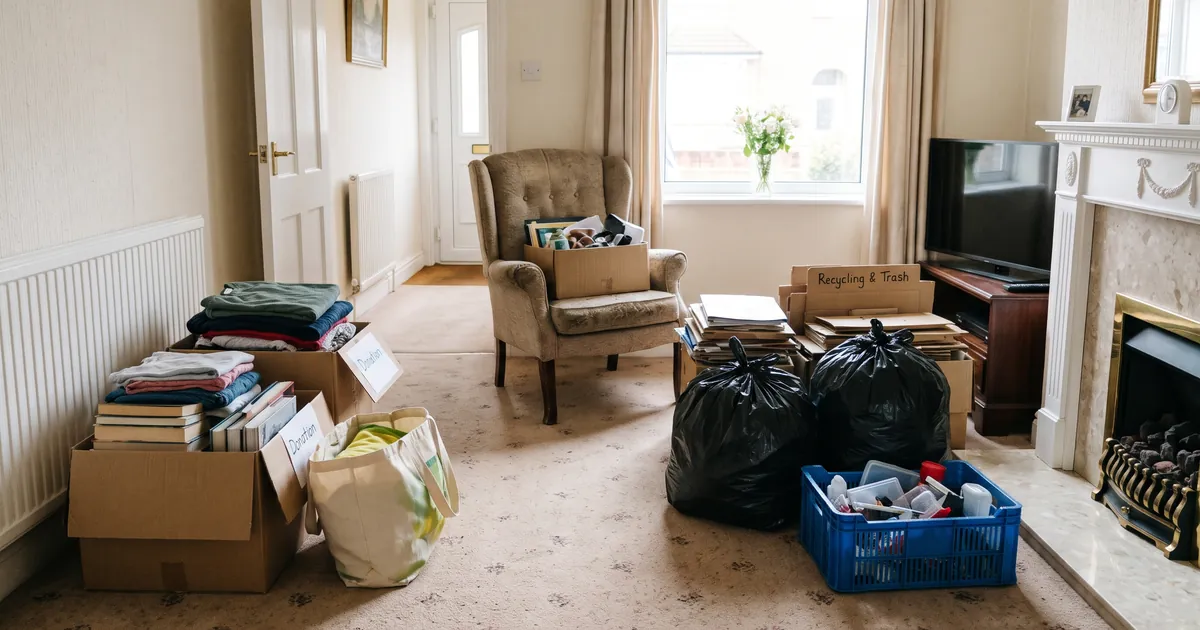
Most decluttering advice fails at the same point: the exit. People sort happily for one weekend, then live for a month with donation bags in the hallway. Learning how to declutter your home means planning where every pile goes before you touch a drawer.
This guide works room by room, and every room ends with the waste route that clears it. A full clearout produces donation bags, recycling, bulky furniture and hazardous leftovers — each stream follows a different legal route. Whole-property clearouts often start with a general household waste collection for the mixed load.
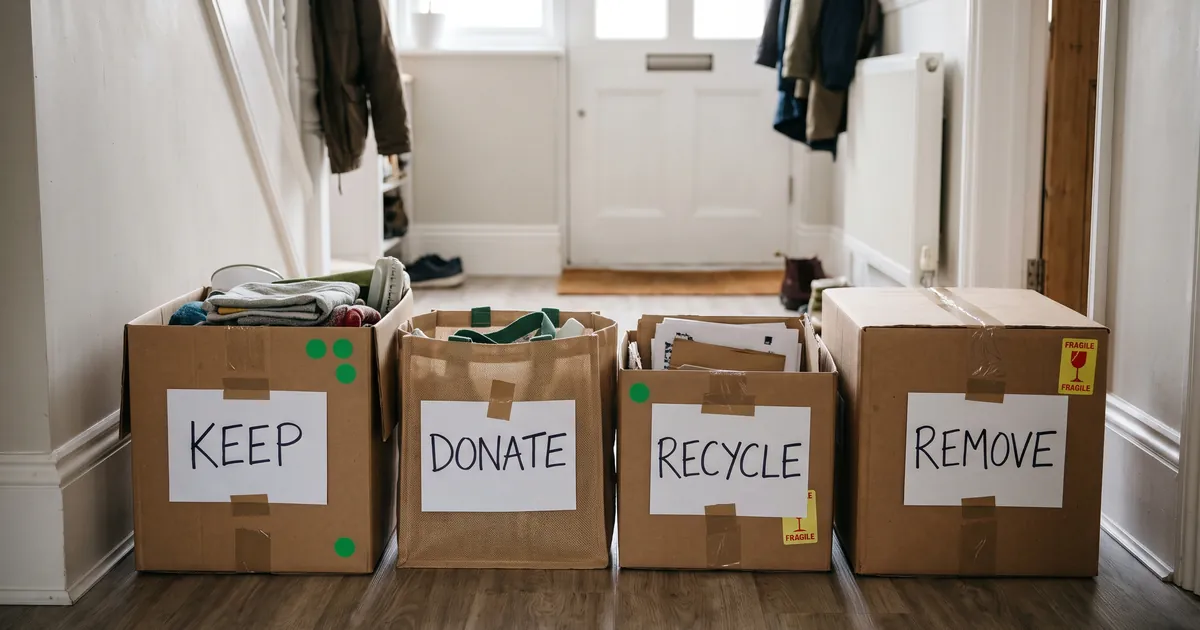
The Four Piles Every Declutter Needs — And the Exit Route for Each
Forget the storage boxes for now. Every serious guide on how to declutter your home starts with sorting, and four piles cover every object in your home:
Keep
It earns a permanent home in the room where you use it.
Donate
Good condition, useful to someone else. Exit: charity drop-off or a booked pickup, within one week.
Recycle
Broken, worn out or single-material. Exit: kerbside bins, a textile bank or a recycling centre trip.
Remove
Too big, heavy or hazardous for the routes above. Exit: a council bulky collection or a licensed crew, booked before you start.
The fourth pile separates this system from every magazine method: most guides end at “bin”, and a three-seater sofa never fits a bin. Name the Remove pile honestly and the clearout stops stalling at the furniture.
One more container helps: a box for items you cannot judge today. Seal it, date the lid three months ahead, and book its exit now. Open it on that date, keep what you missed, and send the rest along the route you already chose.
Your Decluttering Checklist: Book the Exits Before You Sort
Every decluttering checklist starts with bags and labels. This one starts with bookings, because how to declutter your home is a logistics problem first: a booked exit turns sorting into a deadline instead of a hobby:
- Book the bulky route first. Council bulky collections often run waiting lists of one to three weeks. Reserve your date before anything comes apart.
- Book a recycling centre slot if your borough runs a booking system.
- Arrange the charity pickup for donation furniture and bags, or fix a drop-off day.
- Gather the kit: strong bags, boxes, labels, gloves and a timer.
- Set the house rule: nothing sorted stays in the hallway overnight. One staging corner only.
Bookings done, sorting starts. Finish one room and its exits before you open the next — that sequence is the backbone of how to declutter your home without the hallway pile.
Four Questions That Decide Any Item
Decision fatigue kills more clearouts than laziness. Nobody masters how to declutter your home without a decision filter, so run every doubtful item through four tests, in this order:
- The six-month test. If you have not used it in six months, seasons aside, it goes.
- The buy-again test. If you would not buy it again today at full price, it goes. Sentiment survives this test; guilt purchases do not.
- The duplicate test. If another item does the same job, keep the best one. Duplicates fill more cupboards than any other category.
- The exit test. Name where it goes and when — the test most guides never set. An item without a named exit route stays in your hallway.
Speed matters more than perfection: a fast, honest decision beats a perfect one you never reach.
Room by Room: What Leaves and Where It Goes
Rooms produce different waste, so how to declutter your home changes shape in every doorway — and so do its exits. Work through the six zones below in any order, but finish one completely before you open the next. Knowing how to declutter your home zone by zone beats one exhausting whole-house blitz.
Kitchen
Start with food: bin every expired tin, spice and packet, and recycle the clean packaging. Then attack the gadget graveyard — duplicate utensils, the bread maker from 2019, chipped mugs, single-use tools.
Broken small appliances — kettles, toasters, microwaves — count as electrical waste (WEEE). Never bin them: use a recycling centre electrical point or a retailer take-back scheme.
Bedroom and Wardrobe
The wardrobe is where how to declutter your home gets personal, and clothes fill more bags than anything else. Sort by category, run the six-month test on each piece, and split rejects honestly: wearable clothes to charity bags, worn-out textiles to a textile bank.
The spare room usually hides the biggest item: an old mattress. Councils take mattresses through bulky collections, charity shops rarely accept them, and a mattress removal route handles one in minutes.
Living Room
Furniture dominates the living room, and furniture decides how to declutter your home room by room. Donate or sell the pieces with life left, and use a furniture removal route for pieces too heavy to move alone.
Clear the media shelf next: DVDs nobody plays and cables for devices you no longer own go to the WEEE point.
Bathroom
Bathrooms teach the safety side of how to declutter your home. Medicines come first: take expired or leftover medicines back to a pharmacy, which disposes of them safely and free.
Never flush medicines or bin them loose — both routes pollute water and soil.
Then clear expired cosmetics and the hotel-toiletries collection. Rinsed bottles recycle; mixed-material packaging goes to general waste.
Loft, Garage and Shed
The loft is where how to declutter your home turns physical — and hazardous. Paint tins, solvents, weedkiller, old batteries and engine oil all count as hazardous waste. None belongs in a bin, a skip or a bulky collection: your recycling centre runs a hazardous point for exactly these items.
Garden machinery, broken bikes and tyres fill the rest. Working tools sell or donate fast; broken ones split into metal recycling and general waste. A seasonal garden waste clearance route suits the green and timber pile.
Home Office and Paperwork
Paperwork carries data, so it leaves differently. Shred anything with account details, then recycle or compost the shreddings as your council allows.
Dead laptops, phones and printers go to the WEEE point after you wipe the drives. Keep seven years of tax records, scan the rest, and let the paper mountain go.
What Charity Shops and Councils Refuse
Refused items cause the stall nobody warns you about when you learn how to declutter your home. A trip that brings the sofa back kills a weekend’s motivation. Learn the refusal list before you load anything:
- Upholstered furniture without a fire safety label. Charity shops cannot legally sell it, so they turn it away.
- Broken or unsafe electricals. Charity shops cannot test them; WEEE points take them instead.
- Paint, chemicals and oil. Bulky collections refuse hazardous loads on sight; the centre hazardous point is the only route.
- Mattresses in poor condition. Stained or torn mattresses fail charity and some council rules.
- Gas cylinders and car batteries. Specialist return schemes take these, never general collections.
Every refused item has a route — just not the route you first chose. Match item to route while you sort: that single habit is how to declutter your home without the return trips.
The Routes Compared: Cost, Effort and Speed
Your total cost depends on which exits you combine. Compare the five routes honestly:
| Route | Typical cost | Effort | Speed |
|---|---|---|---|
| Charity pickup | Free | You pack and stage | Booked days ahead |
| Recycling centre | Free for residents | You transport everything | Same day, your trip |
| Council bulky collection | Roughly £20–£70 per set of items | You carry items out | Slow — book early |
| Skip hire | From around £150 for a small skip | You load it | Sits on your drive for days |
| Private clearance | Load pricing, from around £99 | The crew lifts and loads | Often same or next day |
Most households mix routes: charity for the good, the centre for the broken, and one booked collection for everything too big to move. That mix is how to declutter your home cheaply without cutting legal corners.
Easy Decluttering Tips That Stop Clutter Coming Back
Knowing how to declutter your home once is a project; keeping it clear is a system. The best easy decluttering tips protect the result, and three habits do most of the work:
- One in, one out. A new coat, gadget or chair enters only when a similar item leaves by a named route.
- The 10-minute reset. Ten minutes each evening return strays to their homes before they form piles.
- A donation basket by the door. Small rejects collect in one place and leave weekly, not with next year’s clearout.
Famous methods agree on the core: KonMari sorts by category, the Minimalism Game removes daily counts, and both succeed because items leave on a system. Pick the frame you enjoy; keep the exit discipline.
When the Pile Outgrows the Car Boot
Some clearouts outgrow DIY routes: a probate property, a house move on a deadline, a loft holding thirty years of boxes. Car trips stop making sense.
Volume is the last lesson in how to declutter your home, and that is where a licensed crew earns its fee.
We clear full properties across London as an upper tier waste carrier, licensed CBDU563052, and issue a waste transfer note for every load — the document that proves your waste travelled legally.
The Mistakes That Turn a Clear-Out Into Fly-Tipping
Good intentions end badly at the kerbside more often than people admit. Avoid the four mistakes that turn a clear-out into an offence — the legal traps inside how to declutter your home:
- Leaving bags and furniture on the pavement for anyone who wants them. Outside an agreed collection that is fly-tipping, and fixed penalties in England reach up to £1,000. Our fly-tipping guide explains how councils trace dumped items back.
- Paying a stranger cash to take it away. Your duty of care survives the handover: if an unlicensed carrier dumps your waste, you share the liability. Check the licence and keep the transfer note.
- Burning the pile in the garden. Treated wood, plastics and upholstery release toxic smoke.
- Hiding hazardous items inside general bags. Paint and chemicals contaminate whole loads and endanger the crews.
Final Thoughts
You now know how to declutter your house the way professionals clear one: decide the exits first, sort room by room, and give every pile a route and a date. A home stays decluttered when nothing enters without a home and nothing leaves without a destination.
Pile too big for the car boot?
Send a photo on WhatsApp and we quote the figure before we set out. The price we quote is the price you pay.
- Load pricing from around £99
- The crew lifts and loads, from any room
- Licence CBDU563052
- Waste transfer note on every job